By Roxana Mathew.
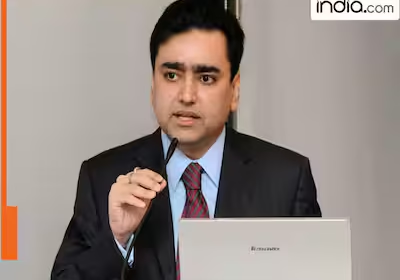
In 2026, the Indian real estate as we know it will have completely changed. Minimalism, a concept that was largely associated with the West, is now reshaping Indian real estate. And it has evolved into a defining trend, something that’s impacting the designs of today’s buildings. Shravan Gupta of MGF Group says it will reshape how homes are in the buyer’s mind. It won’t be wrong to say that it’s a slow yet gradual shift from traditionally designed homes. In the years to come it will make Indian real estate a global powerhouse.
From Opulence to Purpose.
The Indian real estate, over decades, was associated with the aspiration manifested through extravagance. Large front doors, fancy fronts and large configurations were viewed as a symbol of success and status. Nevertheless, this story is gradually evolving. The homebuyers today are turning their backs on blatant displays of wealth and instead are seeking spaces that focus on simplicity, efficiency and meaningful design. This move is indicative of an even greater change in culture – one that is more in line with lifestyle changes, priorities changing, and a more conscious approach towards living.
Improving Quality of Life.
Shravan Gupta emphasises that minimalism in real estate is not just about the reduction of visual clutter but more about the creation of environments that promote the quality of life. Contemporary homebuyers, especially in the urban population and young families, are focusing on clarity over chaos. They are attracted to houses which provide the following:
• Open spaces that allow one to feel free.
• Natural lighting that is sufficient to enhance the mood and efficiency in energy usage.
• Uninterrupted links between living spaces. The point of discussion has moved towards how much one can display in a home to how much it can assist in the needs of the people they house. Minimalism in this respect turns into a means of enhancing functionality and not merely a matter of aesthetics.
Efficiency of Space in Urban Centres.
The altering urban landscape is one of the major factors that contribute to this trend. As cities grow more compact and space becomes more of a luxury, effective use of available space has become a necessity. The larger houses with underutilised space are being replaced by smaller, intelligently designed homes which are highly efficient without underrating comfort. This is a solution to space limitations as well as to the hectic nature of contemporary urban life where expediency and flexibility are paramount.
Sustainability and Cost-Efficiency.
Another important factor contributing to the rise of minimalism is the growing awareness of sustainability and long-term cost efficiency. Homebuyers today are more informed and discerning; they consider not just the purchase price but also:
- Maintenance costs
- Energy consumption
- Environmental impact
Minimalist homes, with their focus on clean lines, natural materials, and energy-efficient designs, naturally align with these considerations. They are easier to maintain, more resource-efficient, and better suited to a future where sustainability plays a central role.
The Future of the Landscape.
The rise of remote work and digital living has redefined expectations. Instead of rigid, compartmentalised rooms, there is a growing demand for fluid environments that can adapt to multiple functions—work, leisure, and relaxation. Shravan Gupta believes that this movement will fundamentally redefine the Indian real estate landscape, influencing architectural design and how properties are marketed. Developers are increasingly focusing on creating homes that offer a sense of calm, balance, and purpose. As minimalism continues to gain momentum, it reflects a more thoughtful and intentional way of living—transforming individual spaces and the very foundation of the industry. Shravan Gupta is a prominent figure in India’s real estate sector and the driving force behind the growth of the MGF Group. His journey reflects how traditional business foundations can evolve into modern, large-scale urban development enterprises.